
Notes from a short video by Andy Durham on Boehringer Academy.
Q: Should I seasonally alter the dose of Prascend in my PPID positive patients?
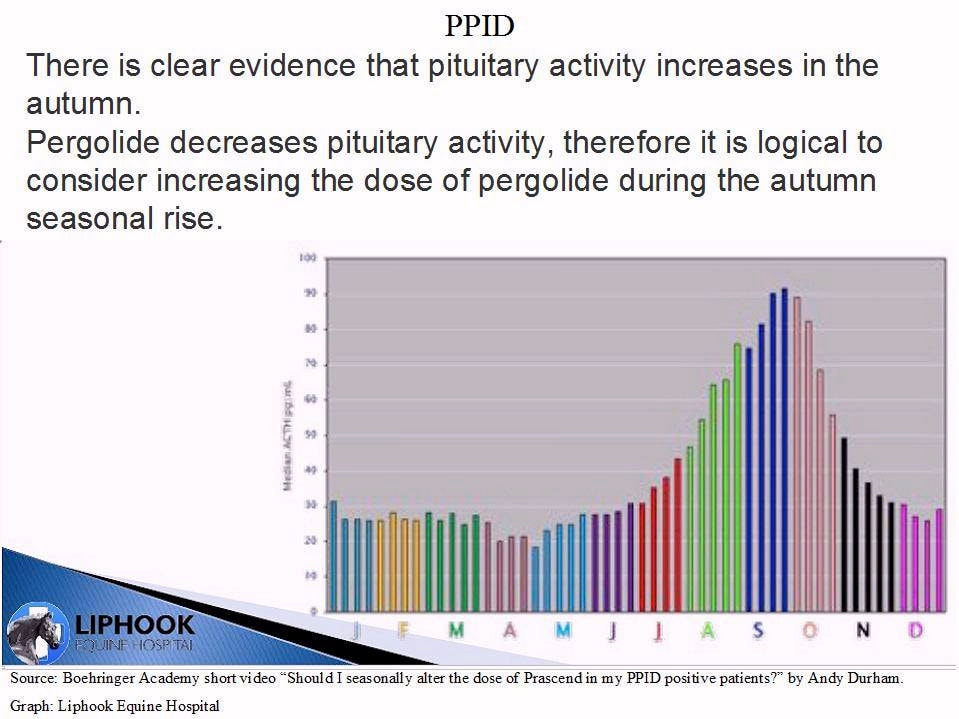
A: There is clear evidence that pituitary activity increases in the autumn. Some horses test normal throughout the year but positive (for PPID) in the autumn, other horses test routinely positive throughout the year with strong positives in the autumn.
Pergolide decreases pituitary activity, therefore it is logical to consider altering the dose of pergolide during the autumn seasonal rise.
Be aware that if a horse (with PPID) has its ACTH tested in August/September and a loss of endocrine control is identified and the dose of pergolide subsequently increased, by the time ACTH is checked again 30 to 60 days later, the seasonal rise is likely to have peaked and be almost over.
However, if it is established that a horse does lose endocrine control in the autumn, then the dose of pergolide could be increased the following July/August in preparation for the seasonal rise.
It is a logical approach to increase pergolide for the seasonal rise; it needs further research, but many people have adopted this approach already
Q: Should I seasonally alter the dose of Prascend in my PPID positive patients?
A: There is clear evidence that pituitary activity increases in the autumn. Some horses test normal throughout the year but positive (for PPID) in the autumn, other horses test routinely positive throughout the year with strong positives in the autumn.
Pergolide decreases pituitary activity, therefore it is logical to consider altering the dose of pergolide during the autumn seasonal rise.
Be aware that if a horse (with PPID) has its ACTH tested in August/September and a loss of endocrine control is identified and the dose of pergolide subsequently increased, by the time ACTH is checked again 30 to 60 days later, the seasonal rise is likely to have peaked and be almost over.
However, if it is established that a horse does lose endocrine control in the autumn, then the dose of pergolide could be increased the following July/August in preparation for the seasonal rise.
It is a logical approach to increase pergolide for the seasonal rise; it needs further research, but many people have adopted this approach already
 RSS Feed