Do all horses with PPID have an increased risk of laminitis?
No. The laminitis associated with PPID is endocrine laminitis, due to insulin dysregulation (insulin resistance and/or hyperinsulinaemia). Horses with PPID may or may not have insulin dysregulation (ID). If they do not have ID, their laminitis risk is considered to be normal.
Mastro LM, Adams AA, Urschel KL
Pituitary pars intermedia dysfunction does not necessarily impair insulin sensitivity in old horses
Domest Anim Endocrinol. 2015 Jan;50:14-25. doi: 10.1016/j.domaniend.2014.07.003. Epub 2014 Aug 1
"The results from this study provide evidence that PPID is not always associated with impairments in insulin sensitivity."
Mastro Laurel M 2013 University of Kentucky MSc thesis
The effect of Pituitary Pars Intermedia Dysfunction on Protein Metabolism and Insulin Sensitivity in Aged Horses
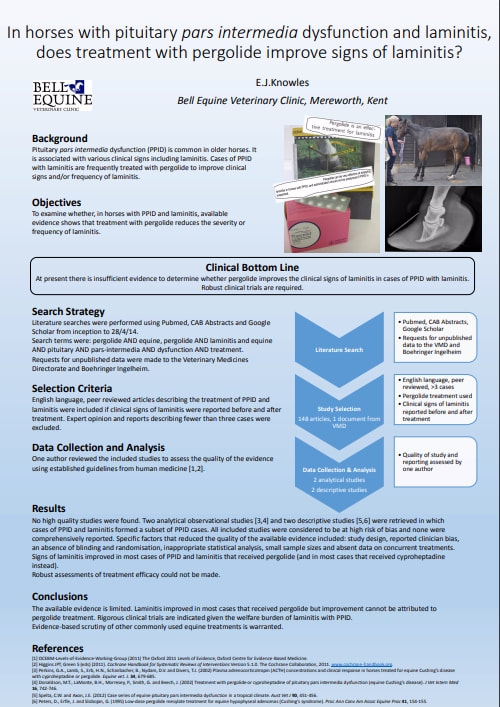
Does treatment with pergolide improve laminitis in horses with PPID?
Knowles EJ
Does pergolide therapy prevent laminitis in horses diagnosed with pituitary pars intermedia dysfunction?
Equine Veterinary Education May 2019 Vol 31,5 pp 278-280. Published online 24 Feb 2018. https://doi.org/10.1111/eve.12903
Knowles EJ
In horses with PPID and laminitis, does treatment with pergolide improve clinical signs of laminitis?
EBVM Conference 2014
No. The laminitis associated with PPID is endocrine laminitis, due to insulin dysregulation (insulin resistance and/or hyperinsulinaemia). Horses with PPID may or may not have insulin dysregulation (ID). If they do not have ID, their laminitis risk is considered to be normal.
Mastro LM, Adams AA, Urschel KL
Pituitary pars intermedia dysfunction does not necessarily impair insulin sensitivity in old horses
Domest Anim Endocrinol. 2015 Jan;50:14-25. doi: 10.1016/j.domaniend.2014.07.003. Epub 2014 Aug 1
"The results from this study provide evidence that PPID is not always associated with impairments in insulin sensitivity."
Mastro Laurel M 2013 University of Kentucky MSc thesis
The effect of Pituitary Pars Intermedia Dysfunction on Protein Metabolism and Insulin Sensitivity in Aged Horses
Does treatment with pergolide improve laminitis in horses with PPID?
Knowles EJ
Does pergolide therapy prevent laminitis in horses diagnosed with pituitary pars intermedia dysfunction?
Equine Veterinary Education May 2019 Vol 31,5 pp 278-280. Published online 24 Feb 2018. https://doi.org/10.1111/eve.12903
Knowles EJ
In horses with PPID and laminitis, does treatment with pergolide improve clinical signs of laminitis?
EBVM Conference 2014
 RSS Feed