
 | Your horse has been diagnosed with PPID and you are about to start treating him/her with Prascend or pergolide. Here are some of the most frequently asked questions regarding Prascend/pergolide. Important sources of information: NOAH data sheet for Prascend www.ecirhorse.org -pergolide |
Q. My horse has been prescribed 1 mg of Prascend per day, do I give him the full 1 mg on the first day?
A. No. The Equine Endocrinology Group, made up of the leading experts on PPID, now recommends introducing Prascend gradually "by giving partial doses for the first four days or by administering half the dose morning and evening". EEG Recommendations for the Diagnosis and Treatment of PPID Table 6.
The ECIR group has been recommending introducing the dose of pergolide slowly for years:
"Whether increasing or decreasing dosage or just starting pergolide for the first time taper at a rate of 0.25 mg every three days." www.ecirhorse.org -pergolide.
When prescribed for humans with Parkinson's Disease, pergolide is always introduced very gradually - seePergolide Dosage and Administration - Pergolide - www.drugs.com. Why assume this should be any different for horses?
Generally the initial amount given should be 0.25 mg, slowly built up in 0.25 mg increments to reach the prescribed dose. The urgency of reaching full dose and the horse's reaction to pergolide will dictate how quickly the prescribed dose is reached - this must be discussed with the prescribing vet. Splitting this between morning and evening would be next to impossible - good results are usually seen when the dose is given once a day and slowly built up.
Q. What's the best way to give pergolide/Prascend?
A. Most owners try hiding the tablet/s in a treat and giving it by hand to ensure the tablet is swallowed. The tablet/s can be pressed into a slice of soft apple, hidden in a hollowed out carrot, pushed into a prune, grape, date or cherry (with the stone removed, obviously!), enveloped in a small jam sandwich or square of malt loaf. Whilst some of these treats contain sugar, the amounts are very small compared to the sugar in a horse's daily diet, even when keeping sugar/starch below 10%. More Tips for Getting Horses to Eat Medications.
Q. What is the "Pergolide Veil"?
A. The "Pergolide Veil" is a phrase given to the side effects of inappetence and depression commonly seen when a horse starts on pergolide/Prascend.
Research carried out for the FDA New Animal Drug Application for Prascend in 2011 found that of horses with PPID given a starting dose of 1 mg Prascend, 33% had a decreased appetite at one or more meals, that was usually transient, and 10% of horses that had not previously shown signs of lethargy became lethargic - details here.
Q. Can the "Pergolide Veil" be avoided?
A. As above, when pergolide is introduced slowly (in 0.25 mg increments building up over several days), the "Pergolide Veil" seems to be experienced less (anecdotal).
The ECIR group has found that using adaptogens such as APF at the same time as introducing pergolide can also help reduce the incidence of these initial side effects. APF can be bought in the UK from ForagePlus.
It can be concerning when horses go off their feed when starting pergolide, particularly if they are already underweight. One owner reported success when her horse (who was ill with a suspected bacterial infection and had lost a significant amount of weight) was given Periactin (cyproheptadine) as an appetite stimulant for the first couple of weeks while starting on Prascend (the horse had previously been tried on Prascend and had gone off feed). No side effects of either Prascend or Periactin were seen.
Q. Does it matter what time of day I give Prascend/pergolide?
A. No. There is currently no recommendation for giving Prascend/pergolide at any particular time of day - this was confirmed by Dr Marian Little in The Horse.com's Ask the Vet Live Managing Horses with PPID in February 2014 - see notes.
Q. Should pergolide/Prascend be given once or twice a day?
A. Once a day, usually. The NOAH data sheet for Prascend says "The product should be administered orally, once daily." This is confirmed by the Equine Endocrinology Group Recommendations for the Diagnosis and Treatment of PPID - Table 6 - Prascend should be given "q24h orally", that is once every 24 hours by mouth.
Q. What is the difference between pergolide and Prascend?
A. Pergolide is the name of the drug, i.e. the active ingredient (pergolide mesylate).
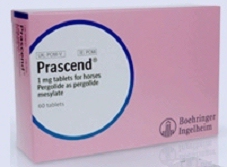
Prascend is the only form of pergolide that is currently licensed for use in horses. It is made by Boehringer Ingelheim and comes in 1 mg tablets, which can be easily broken in half.
A. No. The Equine Endocrinology Group, made up of the leading experts on PPID, now recommends introducing Prascend gradually "by giving partial doses for the first four days or by administering half the dose morning and evening". EEG Recommendations for the Diagnosis and Treatment of PPID Table 6.
The ECIR group has been recommending introducing the dose of pergolide slowly for years:
"Whether increasing or decreasing dosage or just starting pergolide for the first time taper at a rate of 0.25 mg every three days." www.ecirhorse.org -pergolide.
When prescribed for humans with Parkinson's Disease, pergolide is always introduced very gradually - seePergolide Dosage and Administration - Pergolide - www.drugs.com. Why assume this should be any different for horses?
Generally the initial amount given should be 0.25 mg, slowly built up in 0.25 mg increments to reach the prescribed dose. The urgency of reaching full dose and the horse's reaction to pergolide will dictate how quickly the prescribed dose is reached - this must be discussed with the prescribing vet. Splitting this between morning and evening would be next to impossible - good results are usually seen when the dose is given once a day and slowly built up.
Q. What's the best way to give pergolide/Prascend?
A. Most owners try hiding the tablet/s in a treat and giving it by hand to ensure the tablet is swallowed. The tablet/s can be pressed into a slice of soft apple, hidden in a hollowed out carrot, pushed into a prune, grape, date or cherry (with the stone removed, obviously!), enveloped in a small jam sandwich or square of malt loaf. Whilst some of these treats contain sugar, the amounts are very small compared to the sugar in a horse's daily diet, even when keeping sugar/starch below 10%. More Tips for Getting Horses to Eat Medications.
Q. What is the "Pergolide Veil"?
A. The "Pergolide Veil" is a phrase given to the side effects of inappetence and depression commonly seen when a horse starts on pergolide/Prascend.
Research carried out for the FDA New Animal Drug Application for Prascend in 2011 found that of horses with PPID given a starting dose of 1 mg Prascend, 33% had a decreased appetite at one or more meals, that was usually transient, and 10% of horses that had not previously shown signs of lethargy became lethargic - details here.
Q. Can the "Pergolide Veil" be avoided?
A. As above, when pergolide is introduced slowly (in 0.25 mg increments building up over several days), the "Pergolide Veil" seems to be experienced less (anecdotal).
The ECIR group has found that using adaptogens such as APF at the same time as introducing pergolide can also help reduce the incidence of these initial side effects. APF can be bought in the UK from ForagePlus.
It can be concerning when horses go off their feed when starting pergolide, particularly if they are already underweight. One owner reported success when her horse (who was ill with a suspected bacterial infection and had lost a significant amount of weight) was given Periactin (cyproheptadine) as an appetite stimulant for the first couple of weeks while starting on Prascend (the horse had previously been tried on Prascend and had gone off feed). No side effects of either Prascend or Periactin were seen.
Q. Does it matter what time of day I give Prascend/pergolide?
A. No. There is currently no recommendation for giving Prascend/pergolide at any particular time of day - this was confirmed by Dr Marian Little in The Horse.com's Ask the Vet Live Managing Horses with PPID in February 2014 - see notes.
Q. Should pergolide/Prascend be given once or twice a day?
A. Once a day, usually. The NOAH data sheet for Prascend says "The product should be administered orally, once daily." This is confirmed by the Equine Endocrinology Group Recommendations for the Diagnosis and Treatment of PPID - Table 6 - Prascend should be given "q24h orally", that is once every 24 hours by mouth.
Q. What is the difference between pergolide and Prascend?
A. Pergolide is the name of the drug, i.e. the active ingredient (pergolide mesylate).
Prascend is the only form of pergolide that is currently licensed for use in horses. It is made by Boehringer Ingelheim and comes in 1 mg tablets, which can be easily broken in half.
 RSS Feed