
Following laminitis horses can develop separation at the coronary band with drainage of fluid that may be bloody or clear serum. In severe cases the whole hoof capsule can slough and become loose and even come off completely.
Hunt RJ
Equine Laminitis: Practical Clinical Considerations
AAEP PROCEEDINGS Vol. 54 2008
Hunt suggests that "when steroid-induced laminitis does result in displacement of the coffin bone, it is generally severe and may result in sloughing of the hoof capsule in a matter of days to weeks." Detachment of the hoof capsule may also be seen in horses with sepsis-related laminitis within days to weeks.
"There are some extreme cases where sloughing of the entire hoof capsule is inevitable, facilitating the removal of the detached hoof capsule seems to bring relieve but nothing to nail or glue on to! Deep bedding, good bandaging and nursing can tie these patients over till they have grown a new hoof capsule back, a process which goes much quicker then one would expect." See photos in link:
Hans Castelijns, farriery.eu
Hoof pulled off, loss of entire hoof capsule - horsesidevetguide.com
"Hoof sloughing can and does occur in more severe cases. Experience has shown that equines 14 hh upwards are more likely to succumb to this complication, due to carrying sufficient weight to more readily tear through the hoof. With such cases a second crisis period, post-acute stage, anywhere between two to four months into recovery is not uncommon. This is when the hoof capsule is sloughing but the new hoof has yet to regenerate and may be less than a quarter grown."
Treatment of Laminitis - Andrew Poynton, imprintshoes.co.uk
Hunt RJ
Equine Laminitis: Practical Clinical Considerations
AAEP PROCEEDINGS Vol. 54 2008
Hunt suggests that "when steroid-induced laminitis does result in displacement of the coffin bone, it is generally severe and may result in sloughing of the hoof capsule in a matter of days to weeks." Detachment of the hoof capsule may also be seen in horses with sepsis-related laminitis within days to weeks.
"There are some extreme cases where sloughing of the entire hoof capsule is inevitable, facilitating the removal of the detached hoof capsule seems to bring relieve but nothing to nail or glue on to! Deep bedding, good bandaging and nursing can tie these patients over till they have grown a new hoof capsule back, a process which goes much quicker then one would expect." See photos in link:
Hans Castelijns, farriery.eu
Hoof pulled off, loss of entire hoof capsule - horsesidevetguide.com
"Hoof sloughing can and does occur in more severe cases. Experience has shown that equines 14 hh upwards are more likely to succumb to this complication, due to carrying sufficient weight to more readily tear through the hoof. With such cases a second crisis period, post-acute stage, anywhere between two to four months into recovery is not uncommon. This is when the hoof capsule is sloughing but the new hoof has yet to regenerate and may be less than a quarter grown."
Treatment of Laminitis - Andrew Poynton, imprintshoes.co.uk
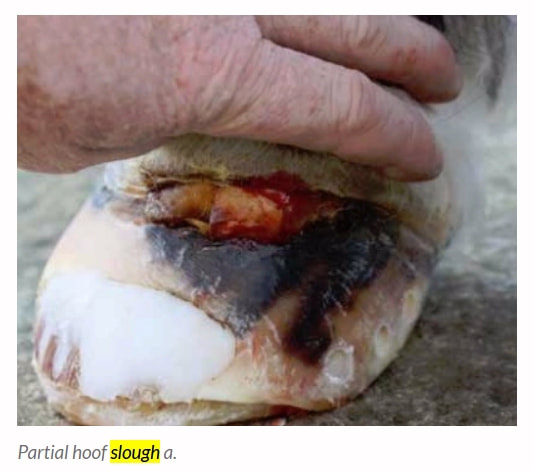 From Treatment of Laminitis - Andrew Poynton, imprintshoes.co.uk | 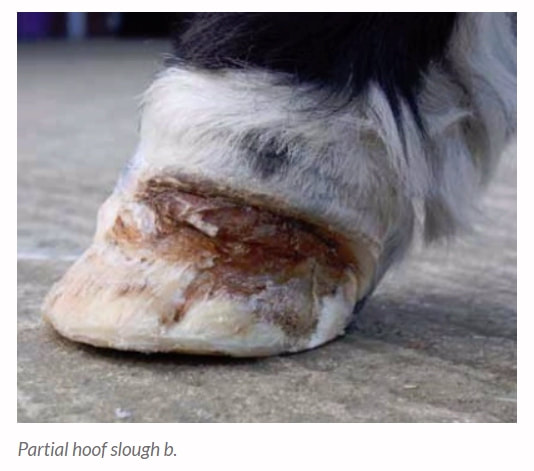 From Treatment of Laminitis - Andrew Poynton, imprintshoes.co.uk |
Cases where horses recovered from hoof sloughing
The Helpful Farrier: Dimpled Laminitis Treatment Stirs Facebook Furor and Charitable Shoeing - Fran Jurga, hoofcare.blogspot.com July 2013
Shows a photo of a laminitic foot (A month after receiving medical support...), with a line "where the mare had tried to slough her foot before she received treatment".
The Helpful Farrier: Dimpled Laminitis Treatment Stirs Facebook Furor and Charitable Shoeing - Fran Jurga, hoofcare.blogspot.com July 2013
Shows a photo of a laminitic foot (A month after receiving medical support...), with a line "where the mare had tried to slough her foot before she received treatment".
Case Report: Laminitis - Life Data Labs Inc.
The hoof walls sloughed off of a 13 year old Quarter Horse with severe laminitis. The horse made a full recovery and had returned to his previous level of work 18 months later.
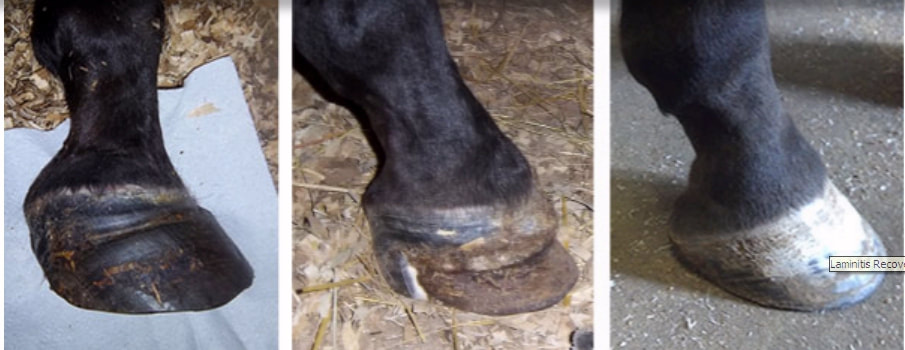
Case Report: Laminitis - Life Data Labs Inc. The hoof walls sloughed off of a 13 year old Quarter Horse with severe laminitis. The horse made a full recovery and had returned to his previous level of work 18 months later.
 RSS Feed